

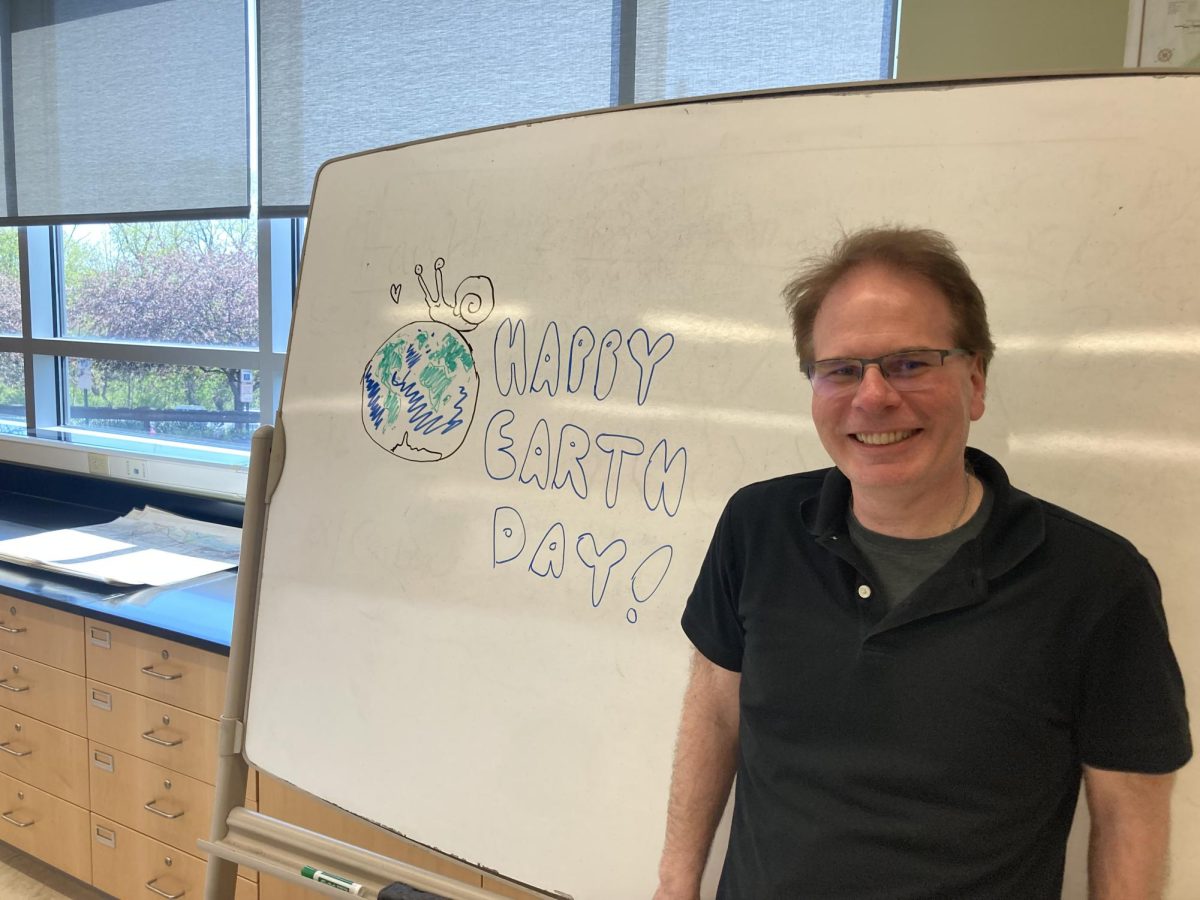
Professor Michael Babij and his courses aren’t just classes to take for credits — they are opportunities for students to learn much about science.
On quiet afternoons in Geology, SCIE103, Babij’s voice fills the room with steady rhythms. His tone is calm and relaxed — the kind that can make students relax and lean in to the lecture rather than tune out. Even though afternoons can feel tiring after a morning full of classes, his discussions bring a sense of focus and ease.
There’s no rush, no booming lecture and no traditional lecture-only format. Babij takes his time teaching and gives students space to absorb the material. He guides his class slowly, aware that students can’t jot down long notes in seconds. He gives them time to see, visualize and understand each topic — ensuring they have everything they need written down.
At the start of the spring semester, Babij helped students relax about the fear of failing his class. He joked about the idea of a future career being jeopardized by doing terribly on one geology exam. The room laughed and understood that this class wasn’t a way to gain credits for whatever major you had, it was a chance to learn about the fascinating world of science and the way Earth works.
He blends assignments and note-taking effectively through labs. After a full session of notes, the labs connect directly to that day’s topic. Depending on how much there is to learn, students can sometimes leave class early once they finish.
At the same time, he doesn’t overload his students with work. He gives a fair amount that can ensure that the students learn something for that day.
His teaching journey into geology began right here at Bucks. As a student unsure of his path, he enrolled in an earth science elective simply because he’d always liked weather as a kid. “I ended up taking it and thought, yes — I really am still interested in this,” Babij said.
This was enough to send him to Millersville University, where he got a degree in Earth and Space Science Education with a meteorology minor and eventually to Mississippi State University for his Master’s.
Babij was born in Bristol, Pennsylvania, in 1976. He began working in Bucks’ Testing Center in October 2006 and has been teaching since January 2009. His calm, relaxing tone may come from something deeper. Babij described himself as “a very shy and private person.” With that comes the fears he mentioned: public speaking and being in front of people. “I don’t like to be the center of things,” Babij said. “But with teaching, it’s kind of different because there’s a purpose to it and everything.”
His teaching philosophy goes far beyond memorizing just facts about rocks and volcanoes; what he wants the most is for students, regardless of their major, to appreciate the world around them. “You don’t have to be a scientist to appreciate nature,” he said. “Even noticing a rock layer or how a stream flows means you’re seeing the Earth differently.”
His classes strongly reflect this belief. Babij trims away the unnecessary details, focusing on core concepts and using visuals, including analogies — like comparing volcanic convection to a lava lamp or sedimentary rocks with melted playdoughs of different colors — to make complex topics feel familiar and simple. Students can feel intimidated by the kind of science course they take. His goal is to break down that wall and replace it with curiosity.
That empathy comes from experience, Babij remembers his first semester teaching back in 2009. The class wasn’t clicking; their first test didn’t go well. Babij offered an opportunity to do test corrections since it was his first ever semester and at that time, tests were worth a huge portion of a grade. Once Babij had a survey for the students to fill out, and the opportunity for the students to get a 2nd chance helped relieve some of the tension. “Once we broke the ice, everything changed,” he said. “By the end, I thought, okay — I can do this.”
He added, “It gave me some insight into how I might need to adjust some of the material and assignments, and better prepare students for the next tests. I noticed that I started to become more comfortable with myself and my personality in the classroom, which helped to strengthen the teacher-student connection and continued to build a sense of community in the classroom throughout the semester.”
Babij expressed how much he loves geology. “When I teach this class, I really do feel a connection to it, like I do with all my classes. So, you know, I don’t know if I can necessarily put any kind of quantity on it — I think it’s a pretty amazing thing. Like, I really do enjoy teaching this class, even though it may not have been my main focus when I was going through college, but I just think it’s really cool to be able to, again, bring all these different things together and present them to students,” he said.
Today, Babij teaches geology, weather and climate, astronomy and physics. Across all of them, he emphasizes scientific literacy — not just learning facts, but understanding how science works. Anytime people have questions, Babij helps and tries to help them understand what the real answer is. In a world that often demands answers immediately, he encourages students to slow down, think and embrace uncertainty. “Sometimes the answer isn’t always the clearest path — and that’s just something that we have to work with because it is a process,” Babij said.
Babij’s teaching style makes him one of Bucks’ most respected and loved professors. His classroom isn’t a place to just earn credits — it’s a place to spark wonder. Whether he’s explaining tectonic plates or how clouds form, his lessons remind students that science isn’t just about memorizing; it’s about observation, curiosity and connection.
He may not seek the spotlight, but in the quiet, steady ways that he helps students see science more clearly, Professor Michael Babij has become exactly what he once hoped to be: a great teacher.